
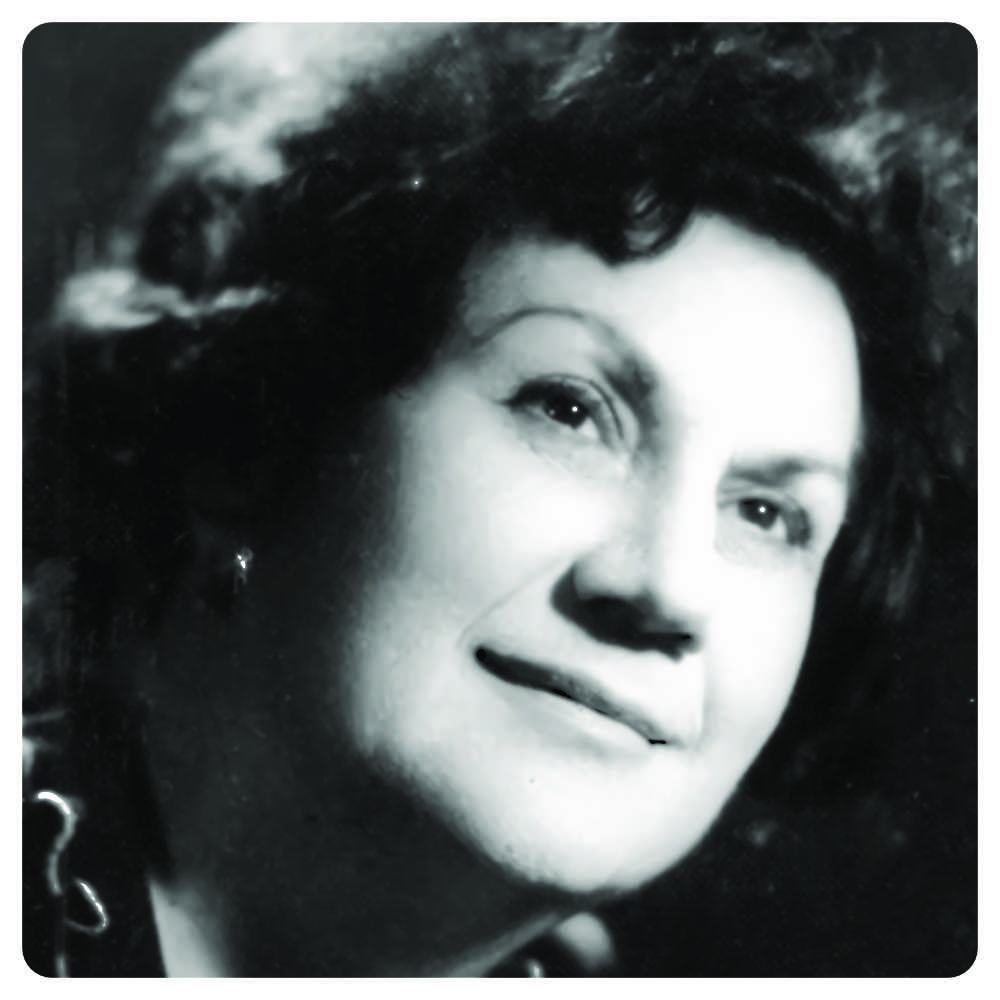
“A first-class pianist, endowed with vivid individuality and a vivid artistic temperament.”
Heinrich Neuhaus
“Music is my life.” This is how Anna Ambakumyan described her own unreserved devotion to the piano, and the phrase has followed her name ever since — it became the title of the monograph devoted to her, and it remains the shortest accurate summary of a career that spanned more than half a century of Armenian musical life.
She was born in Yerevan in 1919, in the first year of the Armenian Republic, and she belonged to the generation that had to build the country’s professional piano culture rather than inherit it. Her first teacher was Yevgenia Khankalamyan in Yerevan. She then went to the Moscow Conservatory, where she studied in the classes of two of the central figures of Russian pianism, Konstantin Igumnov and Lev Oborin, graduating in 1945 and completing her postgraduate studies in 1948. In 1954 she received the degree of Candidate of Art Criticism.
Igumnov’s influence stayed with her for life. She considered herself a representative of the Russian piano school, and she is counted among its Armenian line together with Arno Babajanian, Mariya Gambaryan, Ketty Malkhasyan and Marjan Mkhitaryan. What she took from that school was not a manner but an attitude: a beauty of sound treated as a matter of conscience, a flexibility of phrasing, and a refusal to let technique become visible. Those who heard her described a pianism in which the mechanics simply disappeared into the content of what was being played.
She returned to Armenia as a fully formed musician, and her concert life was substantial. She performed as a recitalist, in chamber ensembles, and with orchestras in Armenia and abroad, working with conductors including Konstantin Saradzhev, Michael Maluntsian, Tauno Hannikainen, Mircea Basarab, Algis Žiūraitis, Arnold Katz, Ohan Durian and Emin Khachaturian. Her repertoire ran from Bach, Beethoven, Chopin, Liszt, Tchaikovsky and Rachmaninoff to Komitas, Khachaturian and Babajanian — and, unusually for a pianist of her standing, deep into the music of her own contemporaries. She gave first performances of piano works by Geghuni Chitchian, Haro Stepanian, Gayane Chebotaryan, Alexander Arutiunian, Stepan Jrbashyan, Eduard Abrahamyan and Eduard Baghdasaryan. In 1972 she recorded a group of Komitas dances, playing them with a vividness in which the dance step and the musical thought were never separable.
The work most closely associated with her name is Aram Khachaturian’s Piano Concerto. She first encountered it in the early 1940s, when Lev Oborin was still its only performer. She came to it herself in the 1960s and played it for the composer, who was struck by how exactly she had understood his music and went so far as to consider recording the concerto with her. Her first performance of it with orchestra took place in 1972 under Aram Katanyan. She was in no hurry with the piece. Colleagues remembered that she brought a work before an audience only when its artistic result satisfied her — and in December 1987, before performing the concerto in Yerevan and Leninakan (nowadays Gyumri), she convened her colleagues, graduate students and former pupils in the special piano classroom of the Conservatory and asked them, quite seriously, to sit as strict judges of her playing. She performed the concerto for them and read a paper on the problems of its interpretation. Those present remembered the evening for decades afterwards. Her last public performance of the concerto took place on 18 September 1987 in the Great Hall of the Yerevan Philharmonic, under Emin Khachaturian.
Alongside all of this stood the work of a lifetime: teaching. She joined the Yerevan Komitas State Conservatory in 1948, headed a department of special piano from 1968, and became a professor in 1972. Over more than fifty years, she trained well over a hundred pianists, many of them prizewinners at international competitions and now teachers themselves. Among her students and assistants were Alexander Gurgenov, Irina and Naira Hakobyans, Gohar Zalinyan, Anna Khachatryan, Armine Soghomonyan and many others.
What she asked of them was exacting and unsentimental. She warned her pupils against indifference and dilettantism, and insisted that the craft of music be learned seriously. In lessons she would press a student to find the singing line and the articulation that reveal the character and style of a piece, and to make even the smallest details of touch serve the image rather than the fingers. Her students went on quoting her to their own students; one of them, Professor Irina Hakobyan, was still correcting pupils in Ambakumyan’s words decades later, so that it became difficult to say where one teacher’s principles ended, and the other’s began. That is perhaps the truest measure of a school.
The line continues. Her postgraduate student Alexander Gurgenov, who completed his studies under her in 1977, went on to become one of the Conservatory’s leading professors, and among his own pupils are pianists of international standing, including Hayk Melikyan and Nareh Arghamanyan. Melikyan, then a boy of about fifteen studying in Gurgenov’s class, was among the young pianists she heard in her final years, and she spoke warmly of what she heard — a small moment, but one that quietly closes the circle between the school she helped to found and the generation now carrying it abroad.
Anna Ambakumyan died in Yerevan on 21 September 1999. Her life and art are the subject of Irina Tigranova’s monograph Music Is My Life (Moscow, 1994), and her own pedagogical credo was published in Yerevan in 2000 as My Pedagogical Principles.
Biography compiled by Alexander Plato Hakobyan